
Understanding cabinets to go prices can be challenging for homeowners planning a kitchen renovation in 2026. With inflation affecting construction materials and labor costs across the industry, many shoppers gravitate toward big-box cabinet retailers promising competitive pricing and nationwide availability. However, the advertised price often represents just the starting point for a complete kitchen installation. Hidden costs, quality trade-offs, and limited customization options can significantly impact the final investment. This comprehensive guide breaks down current pricing structures, reveals what factors drive costs up or down, and helps you evaluate whether stock cabinets deliver the value you need for your renovation budget.
The baseline cabinets to go prices in 2026 typically start around $75 to $150 per linear foot for stock cabinet boxes in basic finishes. This pricing applies to standard-depth base cabinets and wall cabinets in the most common dimensions.
Premium finishes, upgraded door styles, and specialty sizes can push those numbers considerably higher. According to national cost data for kitchen cabinets, the average complete kitchen cabinet installation runs between $4,000 and $13,000, with custom projects exceeding $20,000.
Stock cabinets represent the most budget-conscious option available through national retailers. These factory-built units come in predetermined sizes and finishes with minimal customization capability.
The 10×10 measurement has become the industry standard for price comparison, representing approximately 12 base cabinets, 8 wall cabinets, and basic hardware in a U-shaped layout.
Understanding the complete cabinets to go prices requires accounting for every component beyond the cabinet boxes themselves. Installation labor represents one of the largest additional expenses homeowners encounter.
Professional installers typically charge $50 to $150 per hour, with a full kitchen installation requiring 12 to 20 hours of labor depending on complexity. RSMeans construction cost data indicates that labor costs have increased 8 to 12 percent year-over-year in most markets.
| Cost Component | Price Range | Notes |
|---|---|---|
| Cabinet installation | $800 – $2,500 | Varies by kitchen size and complexity |
| Hardware upgrades | $200 – $800 | Soft-close hinges, upgraded pulls |
| Crown molding | $8 – $18/linear foot | Adds finished look to wall cabinets |
| Filler strips & trim | $150 – $400 | Necessary for proper fit |
| Delivery fees | $100 – $300 | Often not included in quoted price |
Multiple variables affect the final cabinets to go prices you'll pay for a completed project. Understanding these factors helps you budget accurately and avoid surprise expenses during installation.
The construction method and materials used dramatically impact both upfront costs and long-term durability. Stock cabinets typically feature particleboard or MDF boxes with applied veneers or thermofoil finishes.
Solid wood face frames and plywood box construction command premium pricing but deliver superior strength and moisture resistance. Consumer Reports’ kitchen cabinet buying guide emphasizes that box construction quality matters more than door style for overall cabinet longevity.
European frameless cabinets, which eliminate the face frame for more accessible storage, typically cost 15 to 25 percent more than framed equivalents in the same material grade. Homeowners seeking modern aesthetics and maximum storage often find frameless cabinets worth the incremental investment.
Square footage alone doesn't tell the complete pricing story. A galley kitchen with simple runs of cabinets costs significantly less per linear foot than an L-shaped or U-shaped layout requiring corner cabinets and specialized solutions.
Layout factors that increase costs:
Islands represent a particularly expensive component, often requiring custom sizing, electrical modifications, and specialized hardware. A modest kitchen island with seating can add $1,500 to $4,000 to the total project cost.
Many homeowners discover that advertised cabinets to go prices don't reflect the complete investment required for a finished kitchen. Transparency about these additional expenses helps prevent budget overruns.
The advertised price-per-linear-foot rarely includes essential components needed for a functional installation. Cabinet companies often exclude these items to maintain competitive baseline pricing.
Standard exclusions include countertops, backsplashes, plumbing or electrical modifications, and often even basic cabinet hardware. The Cabinets To Go price guarantee outlines specific inclusions and exclusions in their pricing model.
Stock cabinets come in standardized 3-inch increments, which rarely align perfectly with actual wall dimensions. Filling gaps requires custom filler strips, panels, or trim pieces that add cost.
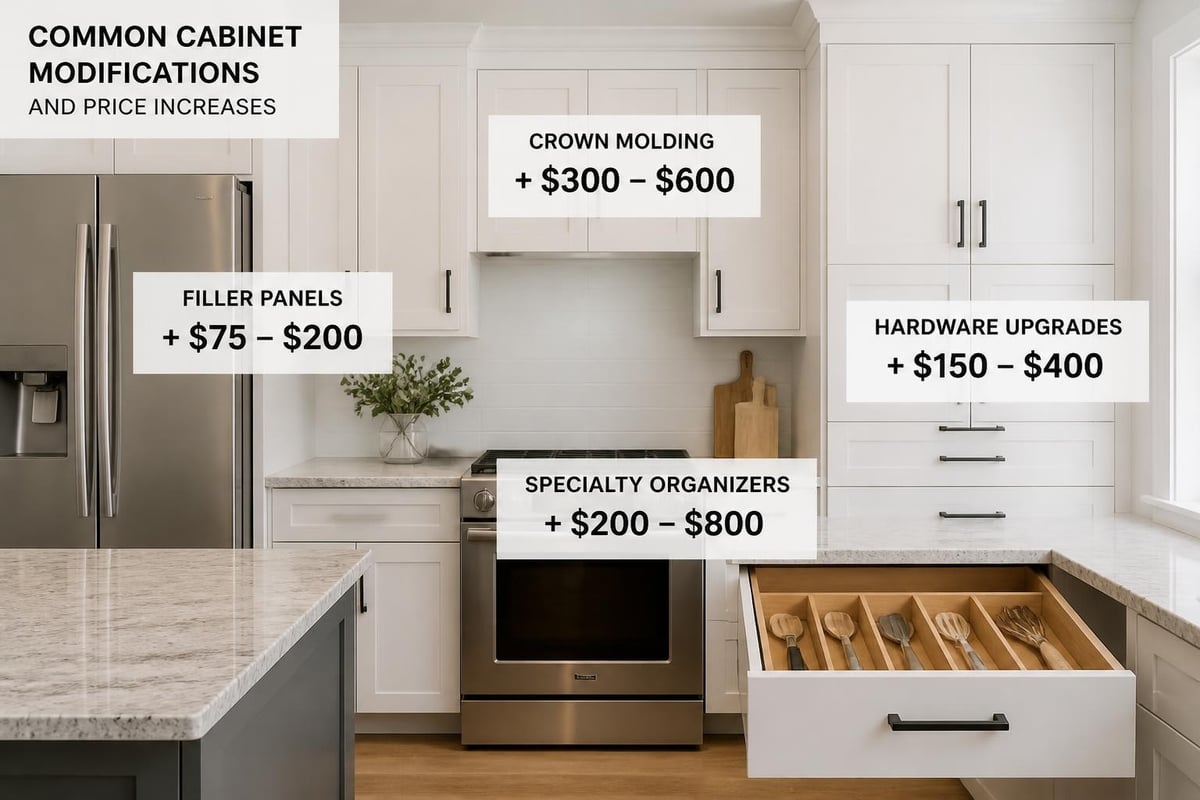
Non-standard heights, depths, or widths require stepping up to semi-custom or custom cabinetry at substantially higher price points. A single custom-sized cabinet can cost 40 to 60 percent more than its stock equivalent.
While researching cabinets to go prices, many homeowners discover that semi-custom options offer better value for projects requiring specific dimensions or higher-quality construction.
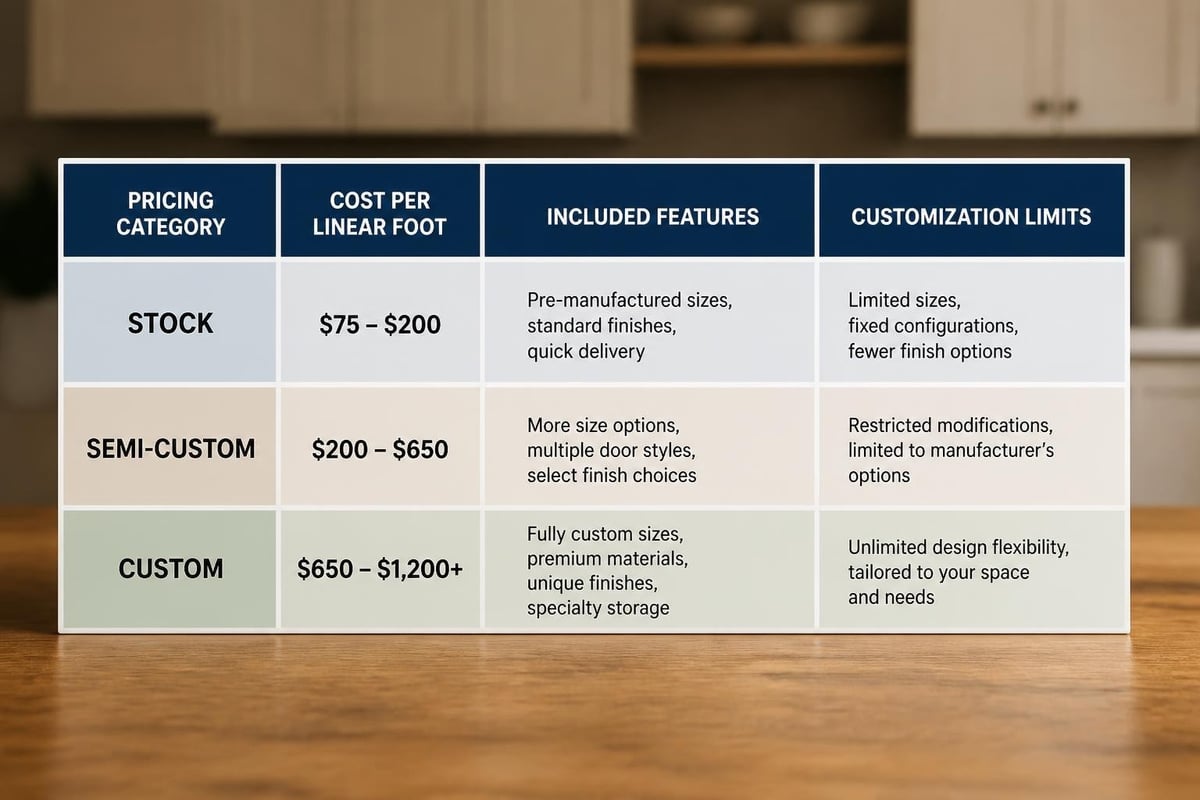
Semi-custom cabinets bridge the gap between stock and fully custom options, offering hundreds of size variations and finish choices while maintaining more accessible price points than bespoke cabinetry.
| Cabinet Type | Cost Per Linear Foot | Lead Time | Customization Level |
|---|---|---|---|
| Stock | $75 – $220 | Immediate – 2 weeks | Minimal |
| Semi-Custom | $150 – $380 | 4 – 8 weeks | Moderate to High |
| Custom | $300 – $1,200+ | 8 – 16 weeks | Unlimited |
Semi-custom manufacturers offer superior box construction, wider finish selections, and modified sizing options. The 2025 Houzz Kitchen Trends Study found that 62 percent of renovating homeowners chose semi-custom cabinets as the best balance between quality and budget.
Fully custom cabinetry eliminates all dimensional constraints and allows for unique finishes, specialized storage solutions, and architectural details not available in production models. These cabinets deliver maximum flexibility for challenging layouts or specific design visions.
Custom USA-made cabinets start around $300 per linear foot and can exceed $1,200 per linear foot for exotic woods, hand-applied finishes, and intricate details. Despite higher upfront costs, custom cabinets often prove more cost-effective for kitchens with unusual dimensions or high-end finishes throughout the home.
Smart shoppers evaluate cabinets to go prices against competing options based on total lifecycle value rather than initial purchase price alone. This analysis considers durability, warranty coverage, and long-term satisfaction.
Ready-to-assemble (RTA) cabinets represent the most budget-friendly option, with prices starting around $50 to $100 per linear foot. This Old House’s RTA cabinet primer explains that homeowners can save 30 to 50 percent by handling assembly and installation themselves.
RTA cabinet considerations:
The actual savings depend on your skill level and available time. Professional assembly services typically charge $30 to $60 per cabinet, which erodes much of the cost advantage.
Wholesale cabinet suppliers operate showrooms that sell directly to homeowners at contractor pricing, eliminating retail markups. This business model often delivers semi-custom or custom quality at prices competitive with big-box stock cabinets.
Wholesale pricing structures typically reduce costs by 25 to 40 percent compared to traditional retail channels. The trade-off involves less hand-holding through the design process and often requires homeowners to coordinate their own installation or hire independent contractors.
Several macroeconomic factors influence cabinets to go prices in 2026, creating both challenges and opportunities for budget-conscious homeowners planning kitchen renovations.
The National Association of Home Builders reports that remodeling markets have stabilized after several years of supply disruptions and price volatility. However, material costs remain elevated compared to pre-2020 levels.

Plywood and hardwood prices have normalized but remain 15 to 20 percent above historical averages. Thermofoil and laminate materials show greater price stability due to synthetic manufacturing processes less affected by lumber market fluctuations.
Geographic location significantly impacts final project costs due to differences in labor rates, shipping expenses, and local market competition. Metro areas with higher costs of living typically see cabinet prices 20 to 35 percent above national averages.
Regional pricing factors:
Coastal markets face additional considerations like humidity resistance and salt-air protection, which may require upgraded finishes or construction methods. For San Diego homeowners, exploring in-stock kitchen cabinets from local suppliers can eliminate freight charges while ensuring climate-appropriate materials.
Understanding cabinets to go prices represents just the first step in planning a successful kitchen renovation. Strategic decisions about where to invest and where to economize can dramatically improve the value equation.
Certain cabinet features and upgrades deliver disproportionate value in terms of functionality, durability, and resale appeal. Prioritizing these elements while economizing elsewhere creates a high-impact kitchen within budget constraints.
High-value investments:
Homeowners can reduce cabinets to go prices significantly without compromising functionality or aesthetics through selective economizing and strategic planning.
Keeping the existing kitchen footprint eliminates plumbing and electrical modifications that add thousands to project costs. Installing new cabinet boxes while reusing existing doors and drawer fronts through refacing represents another major saving opportunity, typically costing 30 to 50 percent less than full replacement.
Additional savings approaches:
Cabinets to go prices often reflect availability advantages over made-to-order alternatives. However, rushed decisions frequently lead to compromised results and change orders that inflate final costs.
Stock cabinets offer the fastest turnaround, with many retailers providing same-week or next-week delivery for in-stock items. This speed advantage makes them attractive for time-sensitive renovations or rental property updates.
Semi-custom cabinets typically require 4 to 8 weeks from order to delivery, while fully custom work extends to 8 to 16 weeks depending on finish complexity and manufacturer capacity. Planning renovations during slower seasons (winter months in most markets) can sometimes reduce wait times as manufacturers have more available capacity.
Industry professionals recommend adding 15 to 20 percent contingency to both budget and timeline for kitchen renovations. Hidden damage behind old cabinets, out-of-square walls, or plumbing modifications frequently extend both costs and schedules.
Ordering cabinets before finalizing appliance selections risks dimension mismatches. Measure twice, order once remains sage advice. Professional design consultations help identify potential conflicts before they become expensive corrections.
The cabinets to go prices you pay should include robust warranty protection that safeguards your investment against manufacturing defects and premature failure. Understanding coverage terms helps you evaluate true value across competing options.
Most national cabinet retailers offer limited lifetime warranties on cabinet boxes and 1 to 5-year coverage on finishes and hardware. These warranties typically exclude damage from improper installation, normal wear and tear, or environmental factors like excessive moisture.
| Warranty Component | Stock Cabinets | Semi-Custom | Custom |
|---|---|---|---|
| Cabinet box | Limited lifetime | Limited lifetime | Lifetime |
| Finish/doors | 1 – 3 years | 3 – 5 years | 5 years – lifetime |
| Hardware | 1 year | 1 – 3 years | 3 – 5 years |
| Installation | 1 year (if used approved installer) | 1 year | Varies by installer |
Read warranty fine print carefully. Some manufacturers void coverage if you don't use their approved installation network, which may charge premium rates compared to independent contractors.
Kitchen updates consistently rank among the highest-return home improvements, but not all cabinet investments deliver equal appreciation. Quality materials and timeless styling preserve value better than trendy designs or budget-grade construction.
Real estate professionals report that well-executed kitchen renovations recover 50 to 80 percent of costs in increased home value, with higher percentages in markets where updated kitchens represent buyer expectations rather than premium features.
Evaluating cabinets to go prices requires looking beyond advertised per-foot costs to understand the complete investment including installation, customization, and long-term durability. While national retailers offer convenience and aggressive baseline pricing, wholesale suppliers and local showrooms often deliver superior value through better construction quality, extensive customization, and direct pricing models. Whether you're planning a budget-friendly refresh or a complete kitchen transformation, SD Kitchen Cabinets provides San Diego homeowners with the largest selection of in-stock and custom options at wholesale prices, backed by free design consultations, professional installation, and a limited lifetime warranty on every cabinet.